How much does brake repair cost in Ontario? An honest breakdown
Short answer: $175–$295 per axle for pads, $385–$650 with rotors, and the number moves mostly on what the salt did to the hardware.
What brake repair costs in Ontario
For a typical car or small SUV, pads only run about $175–$295 per axle. Pads and rotors together, $385–$650 per axle. All four corners done at once, $800–$1,350. Those are market ranges across Southwestern Ontario, not a price list, and they're for a car with nothing seized.
Where you land inside those ranges comes down to what you drive, which parts go on, and what the salt has done to the hardware underneath.
Vehicle class moves it the most. A Corolla and a loaded F-150 don't use the same rotor, and a heavy half-ton's rotors can cost double. Parts tier matters next: an economy pad and a Textar or Bosch pad don't cost the same and don't last the same. On some cars the mid-tier pad is genuinely the smarter buy, because it's quieter and easier on the rotor. Then there's whatever has to come apart that wasn't in the original plan.
| Job | Typical range, Southwestern Ontario |
|---|---|
| Pads only, one axle | $175–$295 |
| Pads and rotors, one axle | $385–$650 |
| Pads and rotors, all four wheels | $800–$1,350 |
| Caliper replacement, per side | roughly $250–$500 on top |
Anyone quoting brake repair cost over the phone without knowing your year, make and model is guessing. That's fine for a ballpark. It's not a quote.
What the quote actually covers
A pads-and-rotors quote breaks into three pieces: parts, labour, and hardware. On most cars, one axle is roughly an hour to an hour and a half of labour. Two axles isn't quite double, because the wheels are already off and the car's already up.
Parts is pads, rotors, and often a hardware kit: the clips, shims and anti-rattle bits that keep the pad seated properly. Those clips are cheap and get skipped by shops working to a price. Skipped clips are why a fresh brake job squeals two weeks later.
Then there's the small stuff that doesn't look like anything on paper. Cleaning and greasing the slide pins. Wire-brushing the hub face so the new rotor sits flat instead of pulsing. That's ten minutes of work that decides whether the job feels right at 100 km/h.
The real warning sign is a quote with no line items. If you can't see what's parts and what's labour, you can't compare it to anything. A high number with three clear lines on it is usually the more honest document. There's more on what a brake job includes if you want the long version.
Do you need new rotors with new pads?
Not always. Anyone who tells you rotors always come in pairs with pads is describing their policy, not your car's condition.
Rotors get replaced when they measure under the manufacturer's minimum thickness, when they're cracked or heat-scored, when they're grooved deep enough to catch a fingernail, or when they're warped enough to pulse the pedal under braking. Every rotor has a minimum thickness cast or stamped into it. A tech puts a micrometer on it and reads a number. That's the whole test, and it gets measured, not eyeballed.
The honest complication in Ontario is that a lot of modern rotors are made thin from the factory, so plenty of them genuinely are at minimum by the time the first set of pads wears out. Rust matters here more than in most places too. A rotor that's fine on thickness but pitted and flaking around the edge from four winters of salt won't give the new pads a flat surface to bed into.
If yours can be safely reused, a good shop will say so and put the pads on. Worn gets replaced. Convenient doesn't.
Why Ontario road salt grows the quote

Most brake quotes that come back higher than the phone estimate come back higher because of the hardware, not the pads.
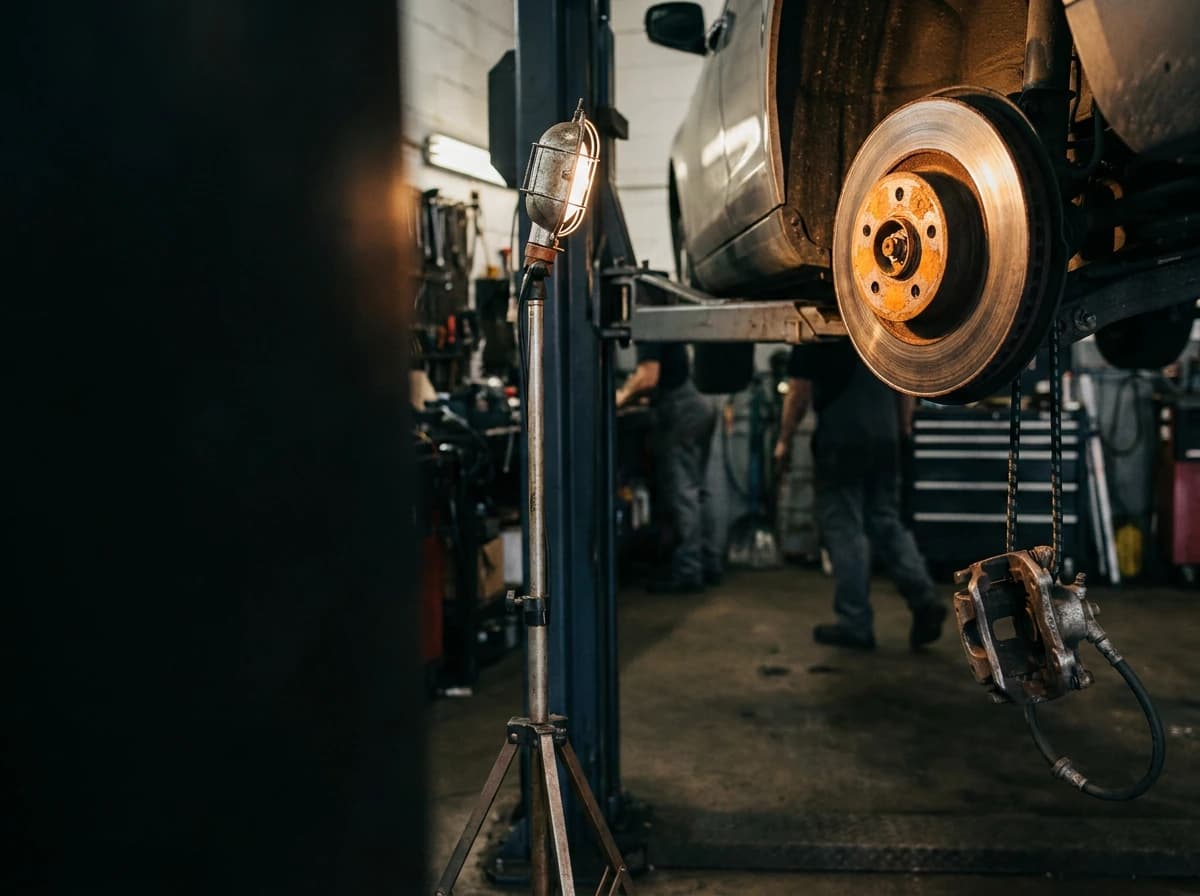
Your caliper floats on two slide pins. They're supposed to move freely so the caliper can centre itself over the rotor and release cleanly when you lift off the pedal. Salt spray off the 401 and every back road between Guelph, Puslinch and Cambridge gets into the boots, the pins corrode, and they stop sliding.
When a pin seizes, the caliper stays partly clamped. One pad wears down to the backing plate while the pad on the other side still looks nearly new. The car drags a little, that corner runs hot, fuel economy drops, and the rotor on that side cooks. Sometimes you can smell it after a highway run — hot metal, a bit like a clothes iron left on.
Sometimes the pins clean up: wire wheel, new boots, fresh high-temp grease, back in service. Other times the bore is corroded past saving and the bracket or the whole caliper has to go, which is real money on top of the pads.
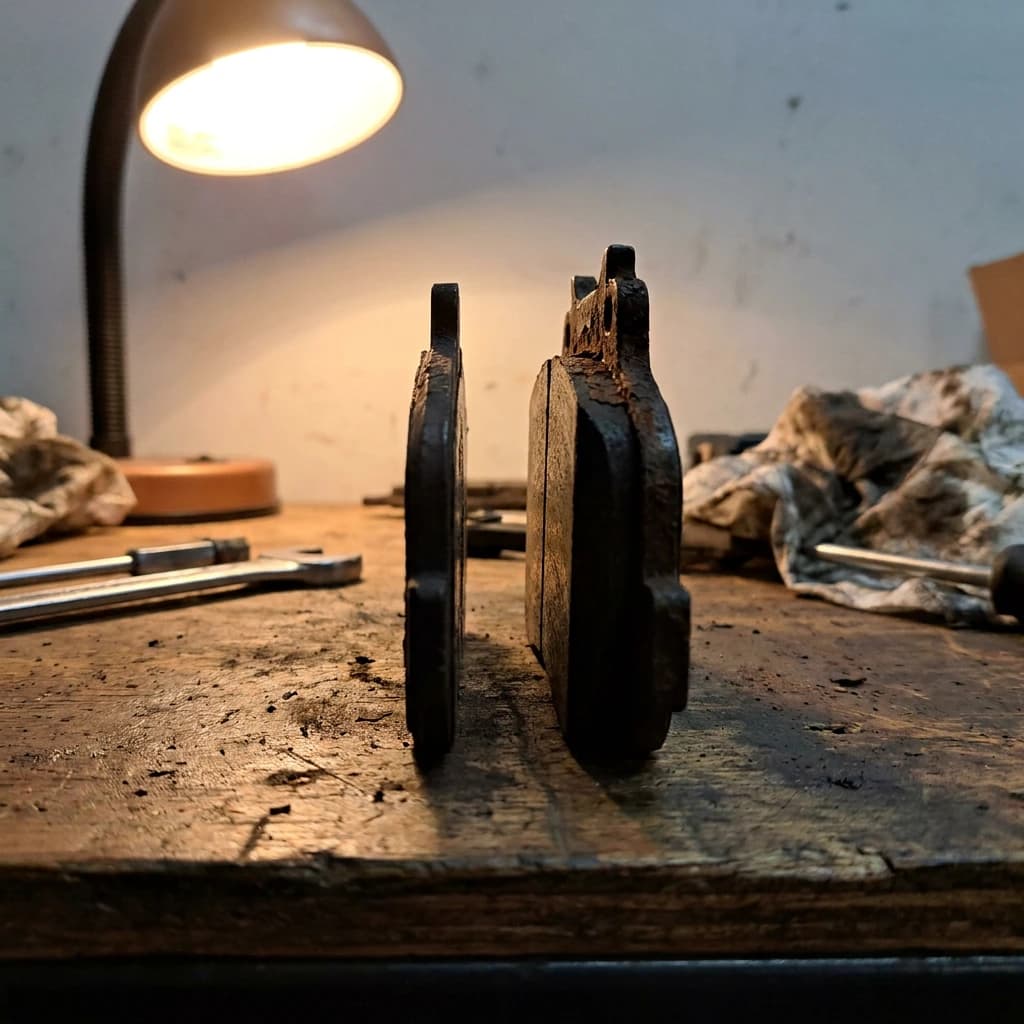
So it's the most common legitimate reason a brake quote grows. It's also the easiest thing in the world to claim on an invoice when nothing was actually seized. That's why the next three questions matter.
How to ask a shop to prove it
Three questions. None of them are aggressive, and any decent shop will answer all three without flinching.
- "Can you show me the seized part?" A stuck pin, a cooked pad, a scored rotor: ask to see it on the bench or on the car. A shop should be happy to walk you into the bay or send you a photo. If nobody wants to show you the part, that's your answer.
- "What did the rotors measure, and what's the minimum?" Two numbers. If the reply is "they looked pretty bad," they didn't measure.
- "Is this a now problem or a soon problem?" A shop that can sort your list into urgent and not-urgent has actually looked at the car. If everything on the list is urgent, nobody looked.
The 10 per cent rule most drivers don't know
Get the estimate in writing. In Ontario, once a shop gives you a written estimate, the final bill can't come in more than 10 per cent above it. On a $600 written estimate, $660 is the ceiling. Not $700, and definitely not $850.
That's Ontario's Consumer Protection Act, 2002, not shop policy, and it applies to every repair shop in the province. The estimate has to spell out the parts, whether they're new or used, the price of each, and how labour is calculated.
It's also why an honest shop stops and calls you when it finds a seized pin. Extra work needs your approval and a revised number, not a surprise at the counter. If a shop won't put the estimate in writing, that's the whole conversation.
Independent shop vs dealer labour rates
Same job, same quality parts, different hourly rate. Independent shops in this part of Ontario generally bill $110–$150 an hour. Dealers are more like $150–$220. On a two-hour brake job that's a $100 to $150 spread before parts, and dealer parts markup usually widens it further.
Dealers earn part of that rate. They carry specialized tooling and factory training, and for certain electronic parking-brake systems that matters. Pads, rotors, hardware and calipers on a mainstream car are routine work either way.
On warranty: your new-vehicle warranty holds when maintenance and repairs are done properly and documented. Keep your invoices, make sure they list the parts and the mileage, and you're covered. We go into that in more detail on our dealer service page.
If you've got a dealer quote in your hand, bring it to us. Most of the time you'll be pleasantly surprised.
Which brake noises can wait
Sort your symptom into one of these buckets.
- Light squeal on cold or damp mornings that goes away after a few stops: usually a watch-it. Surface rust burning off the rotor. Normal.
- Squeal or chirp that shows up under light braking and sticks around: soon. Often pads reaching their wear indicator. You've generally got weeks, not days.
- Pedal that pulses or a steering wheel that shimmies when you brake from highway speed: soon. Warped or unevenly worn rotors. Not dangerous tomorrow, but it won't improve.
- Car pulling to one side when you brake, or one wheel noticeably hotter after a drive: soon, leaning toward now. Classic seized-pin or sticking-caliper behaviour.
- Grinding, scraping, metal on metal: now. Please don't keep driving it. The pad material is gone and you're cutting into the rotor with the backing plate, which turns a pad job into a rotor job and sometimes a caliper job.
- Pedal that sinks toward the floor, or a brake warning light with low pedal feel: stop driving. That's hydraulic, not wear, and it doesn't get better on its own.
We tell you when you don't need the work.
Request a time and the receptionist calls you back, usually the same day. You get a firm price before anything starts.
FAQ
How long should brake pads last?
Most drivers get somewhere between 40,000 and 80,000 km out of a set. City commuting with a lot of stop-and-go lands at the low end; steady highway running lands at the high end. Ontario winters shorten it, because salt and grit act like sandpaper on the pad face.
Can I just replace the front brakes?
Usually, yes. Fronts do most of the work and typically wear out first, often twice as fast as rears. Doing one axle at a time is normal, and nobody should push you to do all four just because the car's on the lift.
Why is my brake quote higher than what I was told on the phone?
Most often a seized slide pin, a caliper that won't release, or a rotor that measured under minimum once the wheel came off. All three are legitimate. Ask to see the part, and ask for a revised quote before any extra work starts. And if you have a written estimate, the final bill can't legally exceed it by more than 10 per cent without your say-so.
Are cheap brake pads worth it?
Sometimes, on an older vehicle you're not keeping long. Otherwise the mid-tier pads from names like Textar, Bosch or Raybestos are quieter, dust less, and are gentler on the rotor, which often means you keep the rotors one cycle longer. The cheaper pad occasionally costs more over four years.
Getting a firm number for your car
To quote brakes properly we need the year, make and model, roughly what you're hearing or feeling, and then eyes on it with the wheels off. Rotors get measured, pads get measured, pins get checked. Then you get a firm number before anything starts, and if the extras turn out to be unnecessary, that's what we'll tell you. Same goes for the rest of what we handle here.
We're off the 401 at Brock Rd in Puslinch, an easy run from Guelph, Cambridge and Milton. Family-owned since 2008, with a 4.7-star average across more than 400 Google reviews.
If your only symptom is a light squeal on cold mornings, watch it and drive on.
We tell you when you don't need the work.
Request a time and the receptionist calls you back, usually the same day. You get a firm price before anything starts.