5 signs your suspension needs attention (and which ones can wait)
Which suspension problems are urgent
Not all signs of bad shocks and struts need fixing this week. A loose or clunking ball joint, a broken coil spring, or a strut visibly weeping oil is a now problem. A tired strut that just feels soft is usually a soon problem, and a bit of extra body roll on a car with 140,000 km on the original dampers can honestly wait while you keep an eye on it.
Here's the sort.
Now: a heavy clunk over bumps paired with vague or wandering steering. A strut body wet with oil. Knocking you can feel through the floor. Those parts hold the wheel in position, and they don't fail gradually.
Next few months: the car bounces two or three times after a speed bump, the nose dives and takes a beat to settle when you brake, tires are starting to scallop. None of that will strand you tomorrow. It does lengthen your stopping distance, and it's eating tires while you wait.
Watch it: leans a little more in corners than it used to, rides a bit softer, nothing else. Note the mileage and check again in a few months.
Most of the signs below sit in that middle bucket. Worth knowing before someone tells you the whole front end needs doing.
Three tests you can run in your driveway
You don't need a lift for the first pass. Five minutes and a flashlight covers it.
The bounce test. Park on level ground. Push down hard on one corner of the car, right over the wheel, and let go. A healthy damper brings the body up once and stops. If it rebounds more than once, or keeps oscillating like a diving board, that damper isn't controlling the spring anymore. Do all four corners so you can compare. One corner behaving differently from its partner on the same axle tells you a lot. One caveat on anything built in the last decade or so: modern dampers use multi-stage valving, and a driveway bounce only really loads the stages that handle big compressions. A newer car can settle in one rebound and still feel tired at 100 km/h. The test is a good first filter, not a verdict.
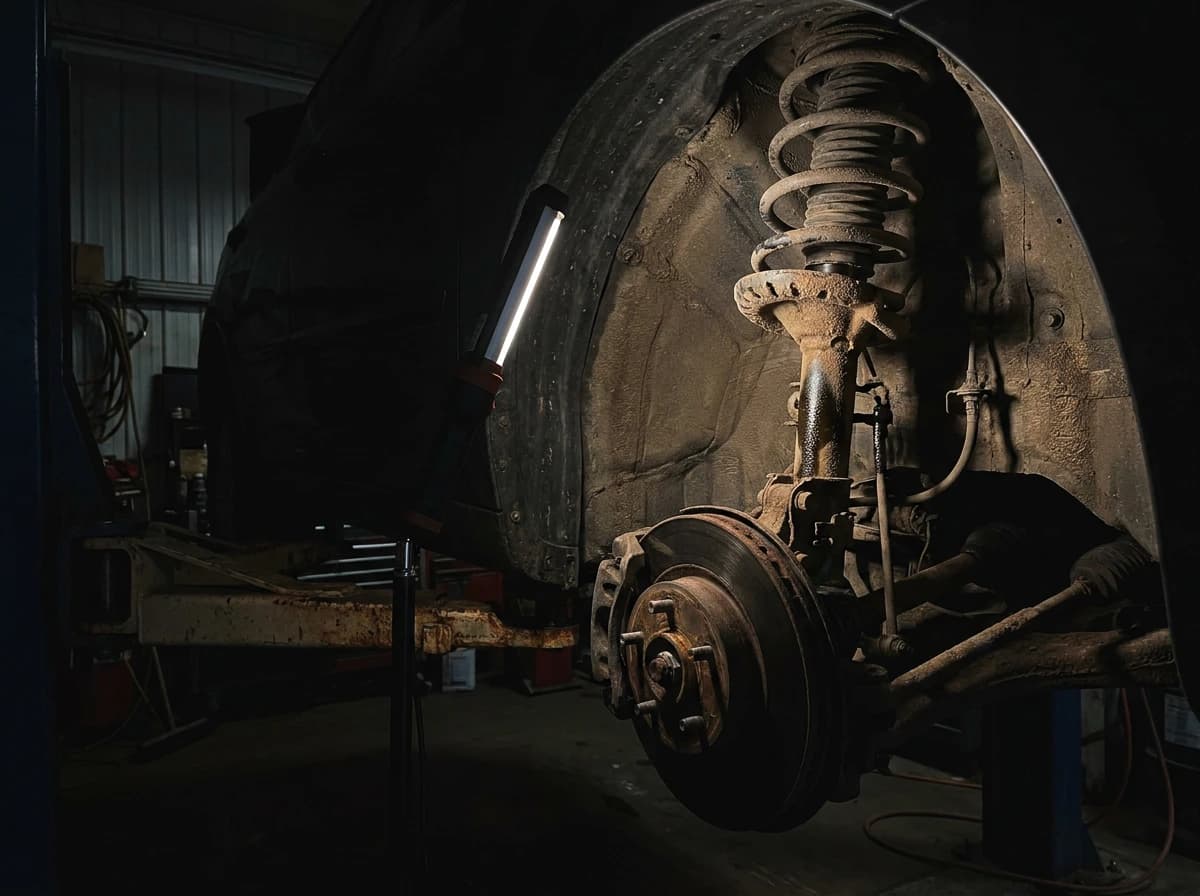
The flashlight check. Look at the strut body through the wheel opening, turning the steering to full lock so you can see more of it. Rear shocks are usually visible from behind the wheel too. Don't get under a car that's only sitting on its own suspension. You want to know whether there's a wet, dirty, oily film running down the housing, usually with road dust stuck to it. That's hydraulic fluid getting past the seal, and a damper with no fluid does nothing. Dry dirt and surface rust are normal after a few Ontario winters. Wet is not.
The hand across the tread. Run a flat palm across the tire tread, side to side, not front to back. You're feeling for scalloped high-and-low patches, like a shallow ripple every few inches. That ripple is the damper's fault, not the tire's.
Sign 1: the car keeps bouncing after a bump
A shock or strut doesn't hold your car up. The spring does that. The damper's job is to stop the spring from doing it over and over.
So when a damper gets weak, nothing sags. The car sits at normal height and drives fine at 50 km/h through town. What changes is settling time. Go over a railway crossing and the body keeps working for a second or two afterward. Over a series of frost heaves the car starts to feel like it's swimming, because each bump arrives before the last one finished.
That matters under braking and in a hard swerve, since a tire that's still moving up and down isn't gripping consistently. It's a soon problem. Book it in the next couple of months. Move it up if you tow, carry a loaded roof box, or run gravel roads regularly, because a weak damper on a loaded vehicle has more mass to fight.
Sign 2: the nose dives hard under braking
Front struts control weight transfer. When they're worn, braking pitches the front end down hard, the rear lifts and unloads, and the car takes an extra beat to level out. It feels like the brakes grabbed and then let go.
People replace pads chasing that feeling and end up disappointed. New pads on worn front struts still lurch.
Here's how to tell them apart. If the pedal is firm and high, the pads have meat on them, and there's no grinding or pulsing through the pedal, but the car still dives and wallows when you stop, look at the struts. If the pedal goes soft, pulses, or the car pulls to one side while braking, that's a brake conversation instead.
A car that dives hard also takes longer to stop from 100 km/h, because the rear tires are carrying almost no load during the dive. You notice it most on the 401 ramps.
Sign 3: clunking or knocking over potholes
Not all clunks are equal, and sorting them is where you save money.
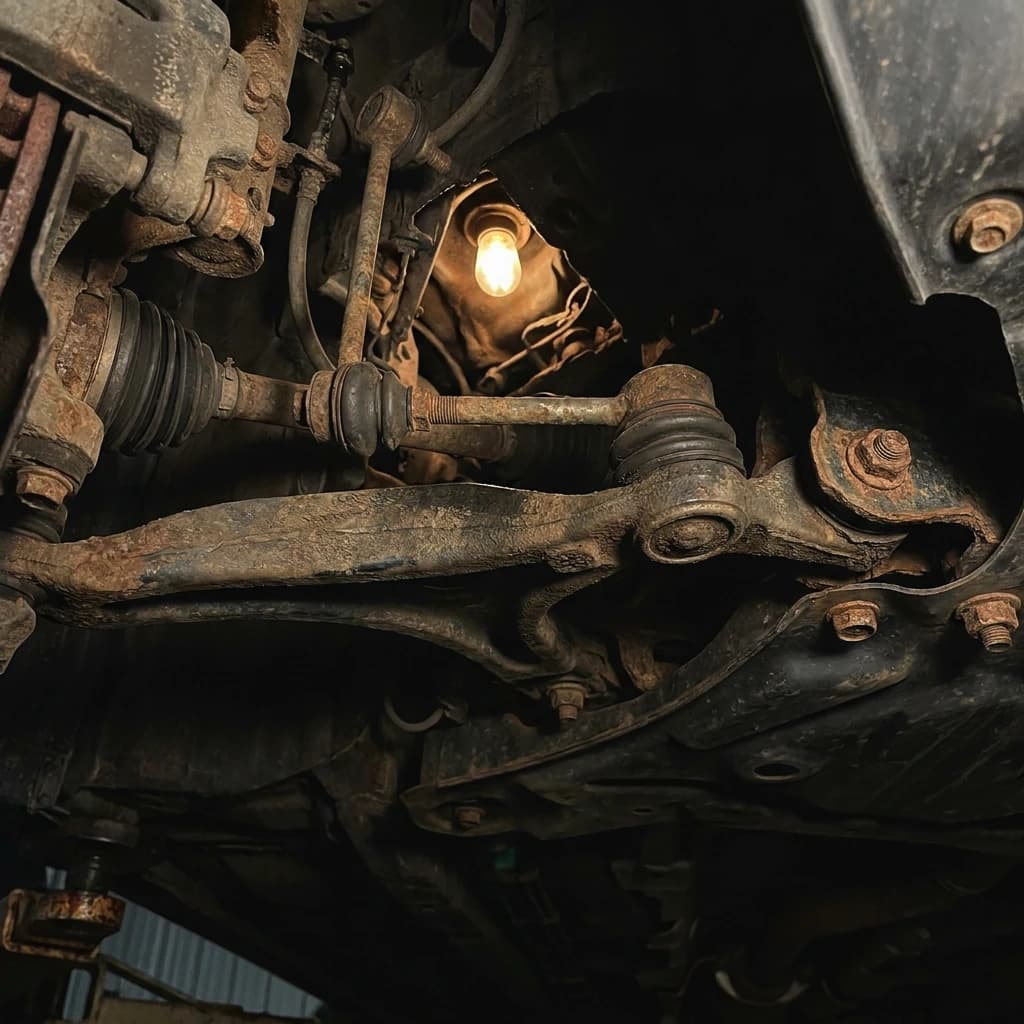
A light rattle or metallic knock over small bumps at low speed, worse on rough pavement, usually comes from sway bar links or worn bushings. Annoying. Cheap parts. Not urgent. Plenty of drivers live with a rattling link for a season and nothing bad happens.
A heavier, hollow clunk with steering that feels vague or has a dead spot is the urgent kind. Ball joints and control arm bushings locate the wheel. When a ball joint gets loose enough to knock, you're hearing play in a part that's supposed to have none.
A clunk that only shows up turning into a driveway at low speed often points at CV joints or a strut mount. Same category: get eyes on it.
This is the one test you can't do in a driveway. Checking a ball joint means getting the wheel off the ground so it hangs free, then rocking the tire top to bottom and side to side feeling for play. With the car sitting on its own weight the suspension is loaded and the play hides. If you've got a heavy clunk and steering that feels vague, that's the point to get it on a hoist rather than keep guessing.
Sign 4: cupped tire wear and a road drone
Read this one before you buy tires. It's the section most likely to save you a set.
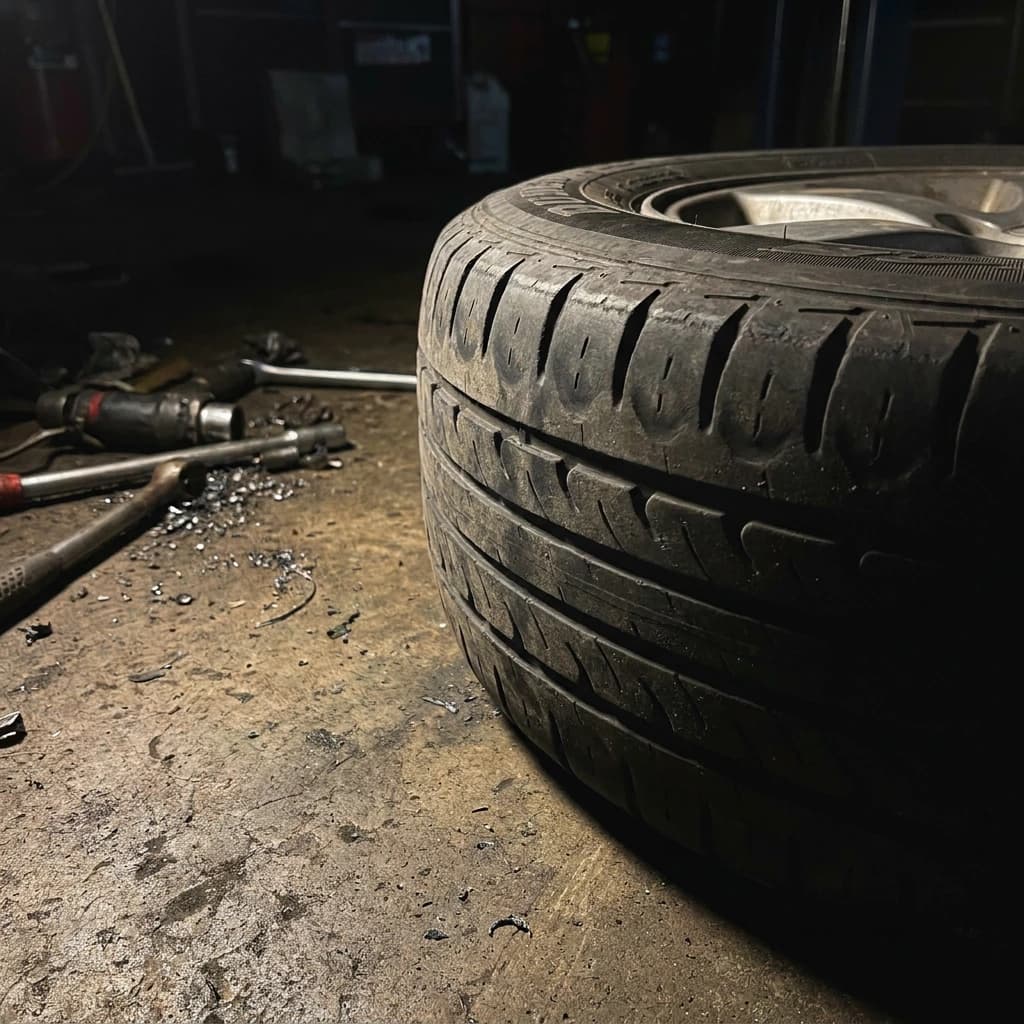
A worn damper lets the tire skip rather than stay planted. Each little hop scrubs a bit of rubber off, and over a few thousand kilometres the tread develops that scalloped pattern, high and low, all the way around. You hear it before you see it: a drone or hum that gets louder with speed and doesn't change when you steer. People blame wheel bearings for this constantly.
Then comes the expensive part. Cupped tires are noisy, so you buy four new ones. The dampers that cupped the old set are still under the car. Twelve or fifteen thousand kilometres later the new tires are scalloped too, and you've paid twice.
Fix the cause first, then put the new tires on. If a set is already scalloped and only halfway through its life, it stays noisy even after new struts, because you can't sand cupping out of rubber. Rotating them buys you some quiet, not a cure.
Cupping isn't always the dampers. Underinflation, a bent wheel, or a worn bearing can produce odd wear too. The bounce test plus the flashlight usually settles which one you're dealing with in about two minutes.
We tell you when you don't need the work.
Request a time and the receptionist calls you back, usually the same day. You get a firm price before anything starts.
Sign 5: floaty, wandering feel on the 401
You know the feeling. You're doing 110 and making small steering corrections you don't remember deciding to make. A transport goes by and its wash pushes you around more than it should. Crosswinds through the open stretch past Puslinch feel like a bigger deal than they used to.
That's the dampers not settling the body between inputs. The car goes light, you correct, the correction overshoots, you correct back. It's tiring, and it makes the car feel bigger than it is.
On its own, this is a soon problem. Get it looked at over the next few months. But if you've also got a clunk, or you found oil on a strut body, or the tires are scalloped, then it stops being one soft symptom and starts being a pattern. That moves it up the list.
Two cheaper things mimic it: low tire pressure and unevenly worn tires. Check pressures cold, at the door sticker number, before you assume it's suspension. Ontario temperature swings drop pressure fast, and a 20-degree drop between October and December takes a few psi out on its own.
What suspension work costs and how we quote it
The honest answer on price is that it depends on the vehicle and on which parts are actually worn. A rear shock on a common sedan and a front strut assembly on an AWD SUV are not in the same universe. There's more on how we approach suspension work if you want the detail. Anyone quoting suspension repair over the phone without seeing the car is guessing.
Two things shape the number.
Shocks and struts normally go in pairs per axle. Replace one front strut and leave a 150,000 km unit on the other side, and the car behaves differently left and right, which shows up in braking and in cornering. A single part looks cheaper on the invoice and drives worse. Both fronts, or both rears, is standard practice for a reason. Doing front and rear at the same time isn't always necessary.
Some parts come as assemblies, some don't. On a lot of newer vehicles the strut, spring, and mount arrive as one preassembled unit, which costs more in parts and less in labour. On others we replace only the damper and reuse a perfectly good spring and mount. If yours can be safely reused, we say so. We replace what's worn, not what's convenient.
What happens when you call: the car goes on the lift, someone looks at the ball joints, bushings, mounts and dampers, and you get told what's worn, what's fine, and which bucket each item falls into. Firm number before anything starts. If what you've got is a rattling sway bar link and four healthy dampers, you'll hear that too.
Common questions
Can I drive with bad shocks and struts?
Usually yes, for a while, if the only symptom is a soft or bouncy ride. The car won't quit on you. What you're giving up is stopping distance and stability in an emergency manoeuvre, so it's not something to leave for two years. If a strut is wet with oil or you hear a heavy clunk, get it looked at now.
Do shocks and struts have to be replaced in pairs?
In practice, yes, per axle. Both fronts together or both rears together, so the car responds the same on each side. You don't automatically need all four. If the rears bounce and the fronts pass the bounce test with dry housings, do the rears.
Why did my new tires wear unevenly again?
Because whatever wore the last set is still on the car. Worn dampers let the tire skip and scallop the tread, and new rubber does the same thing on the same suspension. Check the dampers before buying tires, not after.
How long do shocks and struts last?
There's no fixed number. Original dampers on a car driven mostly on decent pavement often feel fine past 120,000 km. The same parts on gravel roads and frost-heaved concrete can be finished much sooner. Test them rather than going by mileage.
What to do next
If the bounce test settles in one rebound and the strut bodies are dry, it's reasonable to leave it and check again next spring. If you found oil, or you've got a heavy clunk with loose-feeling steering, get it on a lift this week.
Drivers come to us for suspension repair from Guelph, Cambridge and Milton, off the 401 at Brock Rd. Bring another shop's quote if you have one. We'll tell you what we find, including when the answer is that it can wait.
We tell you when you don't need the work.
Request a time and the receptionist calls you back, usually the same day. You get a firm price before anything starts.