Synthetic vs conventional oil: how to tell what your engine actually needs

Which oil does your engine need?
Your engine already told you. The required oil is stamped on the oil filler cap or printed in the maintenance section of the owner's manual, and that spec is the answer: a grade like 0W-20 or 5W-30, usually with a standard or manufacturer approval code beside it. The whole synthetic vs conventional oil argument gets a lot quieter once you've read your own cap.
Two minutes with the hood up settles it. If your car was built for 0W-20 full synthetic, that's not an upsell being worked on you, it's the engine's requirement. If it calls for a conventional 5W-30 and you've been running conventional 5W-30 for nine years, you don't need an upgrade to be safe. We tell people that at the counter and it costs us the difference.
Where to find your oil spec
Three places, in this order.
- The oil filler cap. Black plastic, usually on top of the valve cover. Most are stamped with the grade. Sometimes that's all you get, sometimes you get the approval code too.
- The owner's manual. Look for the maintenance, capacities, or fluids section, not the index entry for oil, which usually just sends you to change intervals. This is where the full spec lives, including the approval code and the oil capacity in litres.
- A sticker under the hood. Less common, and more often found on European cars and some newer trucks. Worth a look if the cap is unmarked.
A complete spec line reads something like: 0W-20, meeting API SP and ILSAC GF-6A, full synthetic. Three pieces. Grade, standard, type. If the cap says one thing and the manual says another, go with the manual. The manual is tied to your actual build.

No manual in the glovebox? Many manufacturers post owner's manuals online for free. Takes longer than reading the cap, but it's the same answer.
What the viscosity numbers mean
0W-20 means the oil behaves like a very thin 0-weight oil when cold and like a 20-weight once the engine is hot. The number before the W is cold flow. The number after it is how thick the oil stays at operating temperature.
Cold flow is the one that matters on a January morning in Puslinch. At -20°C, a 0W oil is still pumpable and gets up to the top of the engine fast. A thicker cold rating takes longer to get there, and those first seconds after startup are when most engine wear happens. That's the short version. We go further into cold starts and intervals in the oil change cost post.
Bigger numbers don't mean better oil. On an engine designed for 0W-20, going thicker isn't doing it a favour. Modern engines have tight oil passages, variable valve timing solenoids, and turbo bearings sized around a specific oil film. Put heavier oil in and you can slow oil delivery on cold starts and nudge fuel economy down. 0W-20 and 5W-30 are two different design briefs, not two quality levels.
Why approval codes matter more than the word synthetic
Full synthetic on the front of a bottle tells you about the base oil. It doesn't tell you the oil passed your manufacturer's tests. The part that does is the small print on the back, and it's the part nobody reads.
Those codes come in two flavours. Industry standards are set by API and ILSAC and get updated every few years: the current gasoline categories are API SQ and ILSAC GF-7, which replaced API SP and GF-6 in 2025, so a manual printed before that will list the older ones, and an oil meeting the newer standard covers an engine that calls for the older one. Then there are manufacturer approvals, which are stricter and brand-specific: GM's dexos1 Gen 3, VW Group's 502 00 and 504 00, Mercedes-Benz's MB-Approval 229.x series, BMW Longlife ratings like LL-01 and LL-04. A bottle that meets one of these will say so plainly, with the exact code.
So an oil can be genuinely full synthetic and still not carry the approval your engine needs. A correctly approved oil is also what keeps your warranty paperwork and your emissions hardware in order. Some approvals exist specifically to keep ash and additive levels low enough not to clog a particulate filter or poison a catalyst. Match the code, not the marketing word.
European engines are usually the strictest about this, which is why we put oil in to the VW-group or manufacturer spec on that work and keep Liqui Moly and Motul on the shelf for it. More on that on the European service page.
Conventional vs synthetic blend vs full synthetic
| What it actually is | Who it suits | |
|---|---|---|
| Conventional | Refined crude base oil with an additive package. Molecules are less uniform, so it thins out faster under heat. | Older engines specced for it, lower-stress naturally aspirated designs, and anyone whose manual calls for a conventional grade. Still a perfectly good oil when it's the right one. |
| Synthetic blend | Conventional and synthetic base oils mixed. The ratio and the additives vary by brand and usually aren't disclosed. | Engines where the manual allows it, or drivers who want better cold-weather behaviour than conventional without going full synthetic. Fine if it meets your grade and standard. |
| Full synthetic | Chemically engineered uniform base molecules. Holds its viscosity better across temperature extremes and resists breakdown and deposit formation longer. | Anything specced for it, which is most vehicles from roughly the last decade: turbos, direct injection, tight-tolerance engines, and anything calling for 0W grades. |
Two honest notes on that table. Synthetic blend has no standard ratio, so a blend from one brand isn't the same product as a blend from another, and the only thing you can hold it to is the grade and the standard printed on the back. High-mileage oil sits outside the table entirely. It's a formulation choice: slightly heavier base, extra seal conditioners and detergents, available in conventional, blend and full synthetic. It makes sense on an older engine that's using a bit of oil or weeping slightly at a seal, and only if it still meets your engine's grade and approval. It won't fix a leak.
For what any of this costs and how often to do it, the oil change cost post covers both.
Can you switch, go back, or mix oils?
Yes, yes, and sort of.
Switching from conventional to synthetic is fine. There's no flush required, no break-in period, no special procedure. Drain the old, in with the new, as long as the new oil meets your engine's grade and approval. The old idea that you can't go back is also wrong. You can return to conventional at the next change if your manual allows conventional in the first place. Modern oils are designed to be fully compatible with each other.
Mixing is the murkier one. If you're a litre low on a road trip and the only thing at the gas station is a different type in the right grade, put it in. A low engine is a worse problem than a mixed one. What you lose is the better oil's advantage: add a litre of conventional to four litres of synthetic and you've got something in between. Top up and get it sorted at the next change.
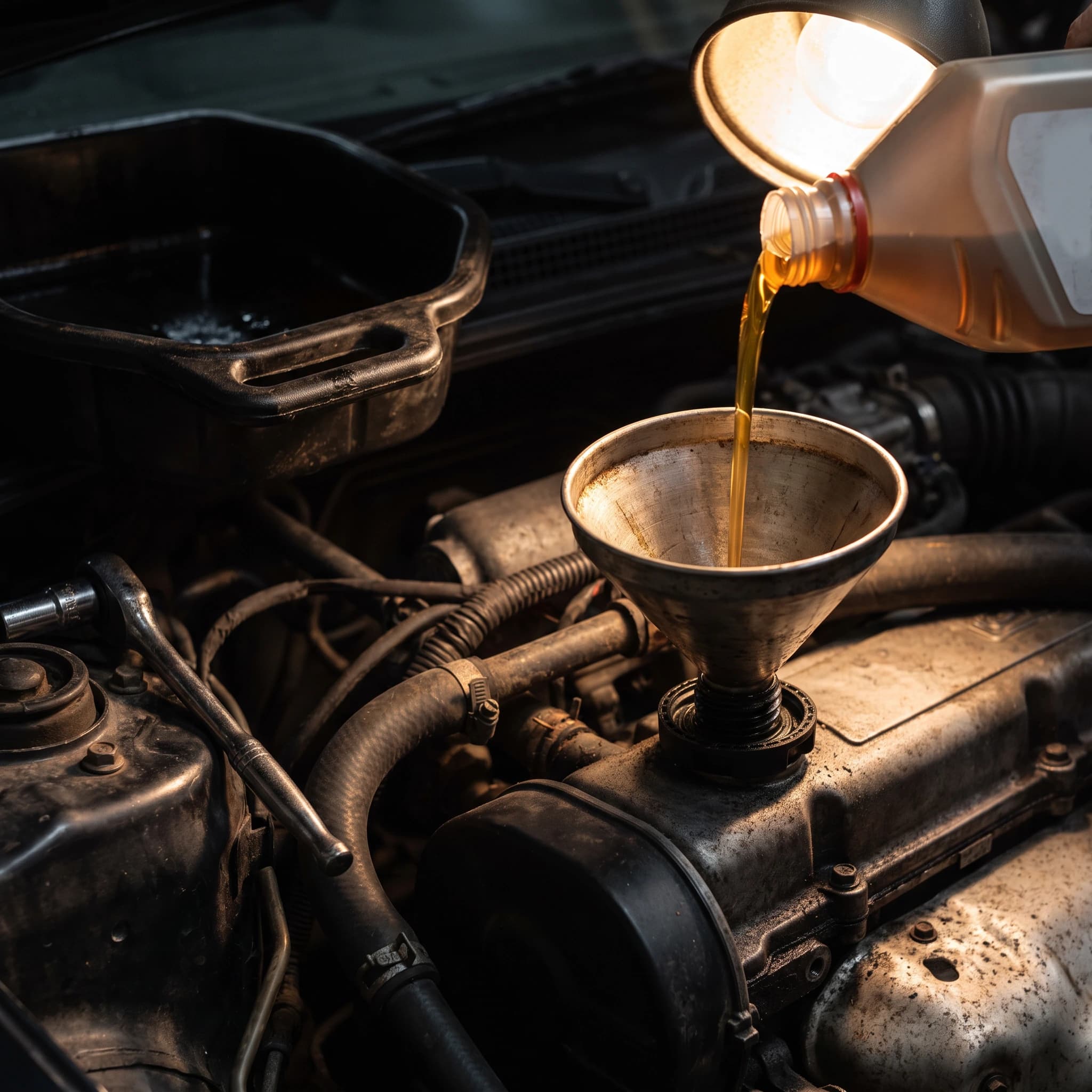
On leaks: synthetic oil doesn't attack seals or gaskets. That myth traces back decades, to early synthetics and seal materials that aren't used on anything you're driving now. What can happen is subtler. Synthetic flows a bit more readily and cleans deposits that were partly plugging a tired seal, so a seal that was already worn can start weeping afterward. It reveals rather than causes. If a drip shows up after a switch, the seal was already on its way out, and that's usually a soon problem rather than a now problem. Depends which seal and how fast it's going. Get it looked at, note the level on the dipstick, and don't panic.
What we do at the counter
We've been doing oil changes since 2008. It's in the name. Conventional or synthetic to your engine's spec, not a house grade. And if your manual says conventional is acceptable and you'd rather not spend on synthetic, we'll tell you that's a reasonable call and do exactly that.
About half an hour, with an inspection included every time: fluids checked and topped, brakes, tires, belts and leaks looked at. You hear plainly what was found, including whether it can wait. The next due date goes on the windshield sticker, and we keep records so your manufacturer warranty maintenance is documented. Regular oil changes with records from a licensed shop keep that intact.
We're at 288 Brock Rd S in Puslinch, right off the 401 at the Brock Rd exit, about 15 minutes from Guelph or Cambridge and 20 from Milton. Walk-ins are fine. Booking guarantees the slot.
Common questions about synthetic oil
Do I need synthetic oil?
If your owner's manual or oil filler cap specifies full synthetic, yes. Most vehicles built in roughly the last decade do, especially turbocharged and direct-injection engines and anything calling for a 0W grade. If your manual lists conventional or a synthetic blend as acceptable, synthetic is optional and the choice is yours.
Can you switch from conventional to synthetic oil?
Yes, any time, in either direction. No flush, no break-in, no special procedure. Drain and fill with an oil that meets your engine's grade and approval. You can go back to conventional later too, provided your manual allows conventional for your engine.
Can you mix synthetic and conventional oil?
It won't hurt the engine. Modern oils are compatible, so topping up with whatever's available in the right grade beats running low. You do give up the better oil's properties, since the result is a blend of unknown ratio. Treat it as a get-home measure and sort it at the next change.
Is synthetic blend as good as full synthetic?
Not quite, and the gap depends on the brand, because nobody discloses the mix ratio. Blends hold up better than conventional in cold starts and heat, though not as well as full synthetic. What actually matters is whether the bottle meets the grade and standard your manual lists. If your engine requires full synthetic, a blend doesn't satisfy that.
Does synthetic oil cause leaks in older engines?
No. Synthetic doesn't attack seals or gaskets, and that story traces back to seal materials used decades ago. It can show up a seal that was already worn, because it flows more readily and cleans away deposits that were partly plugging the gap. If a drip appears after a switch, the seal was already tired. Worth having looked at, not worth panicking over.
What does 0W-20 mean?
It's a viscosity grade. The 0W is how the oil flows when cold, which is what matters at startup on a -20°C morning. The 20 is how thick the oil stays once the engine is at operating temperature. A lower first number means better cold flow, so 0W-20 moves more easily on a cold start than 5W-30 does.
Not sure what's in your engine right now?
Read the cap. If it's blank or you'd rather someone else confirm it, bring the car by and we'll check the spec against your manual before anything goes in. Give us a call or send the request form and we'll ring you back to confirm a time.
More on what's included and what it runs: the oil change service page and, if you're coming from town, oil changes for Guelph drivers.
We tell you when you don't need the work.
Request a time and the receptionist calls you back, usually the same day. You get a firm price before anything starts.